


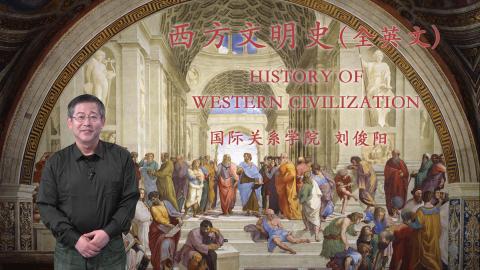

教学团队

国际关系学院
副教授
课程特色
图文(40)
视频(40)
作业(48)
讨论(16)
考试(1)
最新学员


Discussion Topic: The Evolution of Human Civilization and the Pursuit of Spirit Through Historical Figures and Events
I. Background of the Topic
The questions we have explored cover the city-state civilization of ancient Greece (such as Sparta, Athens, and Corinth), philosophical thoughts (Socrates, Plato, Aristotle), the political landscape of Rome (the First Triumvirate), the humanistic awakening of the Renaissance (Leonardo da Vinci), as well as the expansion of ancient empires and cultural clashes (Alexander the Great and Diogenes), along with early modern political reforms (Cromwell and the Commonwealth of England). These elements together outline the development of human civilization from classical antiquity to the modern era, showcasing the exploration and pursuit of politics, culture, and thought across different periods.
II. Core Discussion Directions
1. The Diversity of City-State Civilizations and Political Models
- Sparta, Athens, and Corinth in ancient Greece represented different models of city-state development: Sparta's military oligarchy, Athens' democratic politics, and Corinth's commercial city-state model. We can discuss the influence of these models on the design of later political systems. For instance, what ideological sources did Athenian democracy provide for modern democratic systems? And in what contexts is Sparta's militarized management referenced or reflected upon?
- Comparing the power alliance model of Rome's "First Triumvirate" (Pompey, Crassus, and Caesar), we can consider the contradiction between the balance and centralization of power in ancient politics, and its effect on the rise and fall of empires.
2. The Inheritance and Breakthrough of Philosophical Thoughts
- How did the philosophical systems of Socrates, Plato, and Aristotle shape the foundation of Western philosophy? From Socrates' "midwifery" to Plato's "theory of forms," and then to Aristotle's "empirical research," how did their thoughts progressively deepen humanity's understanding of the world and of itself?
- Relating to the "polymath" trait of Leonardo da Vinci during the Renaissance, we can explore how philosophical thoughts (especially humanism) were implemented in the fields of art and science, breaking the theological constraints of the Middle Ages and redefining the value of "man."
3. The Double-Edged Sword of Imperial Expansion and Cultural Integration
- Alexander the Great's eastern conquests established an empire spanning Europe, Asia, and Africa. His famous quote, "If I were not Alexander, I would wish to be Diogenes," reflects his complex attitude towards power and spiritual freedom. We can discuss the controversy between the cultural dissemination brought by imperial expansion (such as the advent of the Hellenistic period) and violent conquest, as well as the significance of the Cynicism represented by Diogenes in criticizing secular power.
- Comparing this with the Commonwealth of England led by Cromwell, we can consider how bourgeois revolutions in the early modern period promoted social transformation through political reform. What are the essential differences between this and ancient imperial expansion in driving the evolution of civilization?
4. The Spiritual Core of the "Renaissance Man" and Modern Implications
- Leonardo da Vinci was known as a "Renaissance Man," and his versatility embodied the Renaissance pursuit of the "comprehensive development of man." In today's era of specialized division of labor, do we still need this "polymath" spirit? How can we find a balance between deep specialization and interdisciplinary exploration?
- From the Thucydides Trap (the hegemony struggle between Athens and Sparta) to modern international relations, we can consider whether the historical logic of power games still applies today, and whether humanity can draw wisdom from history to avoid conflicts.
III. Value of the Discussion
By connecting and discussing these historical elements, we can more clearly see the internal logic of the evolution of human civilization: from the political experiments of city-states to the cultural integration of empires, from philosophical speculation to artistic awakening, and from ancient power struggles to modern institutional reforms, every breakthrough has been accompanied by a re-answering of questions such as "What is man?", "How should society be organized?", and "How can civilization be sustained?" This not only helps us understand the complexity of history but also provides historical references for contemporary social development and personal growth.
0 回复
- 还没有回复,赶快添加一个吧!
添加回复

 您确定给 “0” 位老师发送协议吗?
UMOOCS用户服务协议
问题分类:
--
